bp_oil_spill_nearshore_trajectory_june18_2010.jpeg
BP oil spill nearshore trajectory june18 2010


The tragedy in the Gulf continues. By now we’ve all seen the horrendous images of seabirds, fish, dolphins, and other forms of aquatic life - dead or dying, helpless as they slither about covered in oil, an agonizing sight for all the world to see.  We’ve seen the Cajun shrimpers bemoan the loss of their lifestyle, and we are witnessing a slow, lingering devastation - as the sea itself seems to be gasping for breath.

As the spill keeps gushing the questions keep coming:

  • Will Florida be soon deeply affected as well?  
  • Will a hurricane stir up the oil even further?  
  • Will the oil flow around the Florida Keys and wash up on the Eastern seaboard? 
  • When will it end?
  • Will BP pay?
BP is certainly to be held responsible. Some conniving political alliances of the past probably as well. No doubt such a catastrophe could have been avoided if more preventive thinking (North West Blue Quadrant of The Intuitive Compass™) had been involved in the management of this underwater well and if decisions had been made based on sustainable value as opposed to shareholder value. Of course there is nothing wrong with compensating the financial risk of a shareholder or an investor. But the sole focus on financial ROI can easily lead to very unbalanced situations. BP and the oil spill in the Mexican Gulf is one more proof of such limited thinking. The many other global sustainability issues as well.

But rather than focusing on BP as the scapegoat of our anger and sorrows few key facts need to be remembered though in order to draw deeper lessons from the current situation in the Mexican Gulf and bring forth a call for meaningful change. Let’s look at the diagram below.

sourceofoilinocean.png
Average annual contribution to oil in the ocean (1990-1999) from major sources of petroleum in kilotonnes. 
From Oil In The Sea, Ocean Studies Board and Marine Board of the National Academy of Sciences (2003).

Statistics show that above nearly 85 percent of the 29 million gallons of petroleum that enter North American ocean waters each year as a result of human activities comes from land-based runoff, polluted rivers, airplanes, and small boats and jet skis, while less than 8 percent comes from tanker or pipeline spills.

So what BP’s mistake is revealing is that all our  human operations and our system of wealth creation need to be reconsidered when it comes to oceans preservation. 

Not only BP but most of us in business still base our decisions on a very limited perspective and understanding of progress. By focusing primarily - and at times exclusively even - on the North East Yellow Quadrant and the South East Green Quadrant of The Intuitive Compass™ we essentially destroy the foundations of our existence and upset the fundamentals of life on the altar of logic and linear efficiency.

We leave out our best instrument for adaptive and sustainable decisions: Instinct. Simply put neuroscience has now proved that there is intelligence in our guts and we all know that instinct is responsible for our survival; that is its main function.

So even if our brilliant human logical mind has been able to invent amazing technological and scientific solutions all around it is yet very limited when it comes to shift paradigm and emancipate from its own way of reasoning. Logic only knows what’s logical. This is why in the name of logic one can become totally illogical because logic leaves out the part of life that eludes our logical mind. And as we can all testify from experience: life and logic don’t match! It takes imagination and courage to go beyond logic. To engage in a new path status quo needs to be challenged. It costs more effort, more risk taking, more energy and requires independent and creative thinking.

Today that level of in depth and courageous thinking is required. That level of commitment and determination to change is unavoidable.

The good news is: it is possible!

Muhammad Yunus proved it with microcredit. He challenged the status quo. He claimed that poverty is not a necessity of our system of development. He showed that it can be efficiently dealt with. He imagined and thought out a powerful way of empowering poor people to go beyond their limits. He organized lending money for the poor and showed that poor people can be more reliable that solvent people by traditional standards. He shifted the paradigm of credit and made a huge impact: nearly 8 million individuals are members of Grameen Bank (a total of 40 million people impacted when you count their family members). Since its inception thirty three years ago Grameen Bank has lent more than $ 8 billion US dolllars to the poor in Bangladesh. 

So how does one start an enterprise that reaches nearly 40 million people in one’s own country and improves the lives of tens of millions more in replications around the world? How does one create socially sustainable prosperity?

Through imagination, intense feeling, courage (i.e. rage of the heart), and deep thinking while not being afraid of paradoxes and commending a holistic view of life where all count, paying attention to unusual cues into powerful creative solutions, by humbly accepting that we cannot control life but committing to influence our individual and collective destiny. 

This exact same approach also applies to our relationship with Nature, seas and oceans. This equally applies to business model reinvention and innovation. In other words we can innovate and create prosperous businesses even in recession times and their impact can be positive, meaningful and economically, socially, and environmentally sustainable.

It is time to rethink the way we think… Not from a fragmented paradigm where logic and linear efficiency prevail in an exclusive manner but from a holistic and inclusive paradigm that is both creative and sustainable, intelligent and relevant. This is why Intuitive Intelligence and The Intuitive Compass™ were invented. This is why i do what i do.

There's a post on the HBR blog - Tell Your Gut to Please Shut Up - by Michael Schrage, a research fellow at MIT Sloan School's Center for Digital Business, in which he denounces the current trend about intuition as the key to quick, effective, successful decision-making.

Although Schrage's argument seems to make perfect sense, and his ideas are well articulated, I think this is just another false debate about intuition.

To be intuitive does not necessarily make any one a better decision-maker, as much as having access to a lot of data is in and of itself not enough to make a good decision.

Schrage's view is a common misrepresentation of intuition. 

In reality, intuition is not about being right or wrong. Instead, intuition is a human aptitude that allows us to take in information that is not obvious to the conscious part of our mind that responds to logic. In other words, you may perceive something or feel a certain way about someone or a situation, and this perception and/or feeling may seem very real and yet simply does not make sense from the point of view of logic. But the fact that it does not make sense logically does NOT mean that it does not have any value... far from that, actually.

This phenomenon is often the foundation for many meaningful scientific breakthroughs. It is also the reason for great art, and even successful medical diagnoses!

What do you do in the face of information that does not seem to make any sense yet keeps your attention?

This is when your imagination and your capacity for induction as well as your sense of discrimination, your analytical mind, and your experience are all at once put to test.

Our analytical mind and our instinct work together to make successful choices.

Let's remember that a few years ago research at MIT Picower Center for Memory and Learning showed that parts of our reptilian brain (or instinctual brain) participate in sophisticated decision making: simply put there is intelligence in our gut instinct.

For this to occur, we need a medium to exchange data between the conscious and the non conscious planes of our mind. This is the function of intuition: to inform (not to decide). And this is why Intuitive Intelligence is defined as the ability for our analytical mind and our instinct to function in synergy thanks to our intuition

Now why is Intuitive Intelligence a fundamental concept in business today? And why is intuition an important subject that must be well understood, not misrepresented? Why? Because logic alone cannot bring the level of creativity and reinvention we need to innovate and win in the global economy. Breakthrough ideas can only come from our unconscious mind (otherwise they would not be new ideas!) so we need to access the part of us that is beyond our conscious mind. And what's beyond our conscious mind does not respond to logic!

Every entrepreneur who launched a successful business would tell you that at some point he or she made a critical decision based on gut instinct, because when you create something meaningful that does not have any existing equivalent you will have to rely on your own judgement beyond any logical framework of reference. That's the difficulty of launching a new business. You have to step in the unknown.

So to answer Michael Starge's question at the end of his HBR article: "So did I write that based on empirical observation? Or because I'm trusting my gut?

My answer is loud and clear: hopefully, both! Otherwise - with all due respect - "that" runs a high risk of being just another platitude.
Not long ago, at the airport, I had a conversation with John - a business man in his early 40s. 

Since I consult in the highly-challenged paper media industry I asked him how he feels about reading magazines and papers.

I assist a major firm identify the fundamentals of the media of the future, facilitate a culture of innovation and accelerate the reinvention of their business model. For those of you less familiar with the challenges of this industry in the US  let me tell you what they are in this digital age:

- increasingly, online destinations attract the attention of large audiences
- most paper magazines have a hard time retaining their audience
- advertising dollars shrink as a consequence
- media company try desperately to expand revenues on the web repurposing a somewhat irrelevant editorial legacy

So let's come back to my conversation with my fellow traveler at the airport. He's a best selling author, considered as a thought-leader in his field of expertise. To respect his privacy, I'll keep his name and further details about his profession confidential.

He tells me that he has not spent a dollar on a newspaper or a magazine for months, probably years!

So I asked him to share with me his reasons for this. He tells me that he already has access to more information than he could read: he receives the
NY Times online newsletter everyday, as well as the Economist weekly; he checks the news on Google and the Daily Beast. Three times a week, he watches CNN at the gym for 45 min. as he runs on the treadmill. He browses the web constantly.

Overall, he prefers e-newsletters over online subscriptions because of time constraints - with a subscription he has to wait for the entire digital edition to download on his screen, but with an e-newsletter is only one click away from the information. Time is of essence for him and much more important than the marginal information he can only have via electronic subscriptions or paper versions.

Besides, he flies internationally very regularly and enjoys access to more magazines and newspapers - both US and international - than he could wish for.
He tells me that he prefers electronic information because he can save articles and send them easily to his clients or his assistant.  Simply put,
he does not need to buy any general information - a pretty gloomy statement for traditional media owners!

But further into the conversation, I find out that
he pays $150 to receive the McKinsey Quarterly. For $150 he can get a yearly online subscription with Newsweek and receive in the mail GQ, Car and Driver, and FT everyday!

So, where's the solution?

As always, the solution will not come from a financial equation alone - there is no imagination in 2+2 = 4 - yet most traditional business thinking comes back to : "what's the business model?" meaning "how do we make money?"

These questions are obviously necessary questions but they're also paralyzing! That's the conventional north-east quadrant approach in the Intuitive Compass™.

The appropriate questions are:
"how do i bring value to my readers?" and "what is my reader trying to achieve?"

Let's go back to the roots.
What does "media" mean? It means "in the middle" - media stands between people and information and facilitates news and information sharing.

If we come back to my conversation it's not difficult to see how to bring value to John, i.e to stand between John and a world of information in a way that's relevant and significant! He needs:

- cutting edge information to keep ahead of the curve in his business
- quick access and very easy repurposing of information
- a search engine that is customized to his very specific profile (profession, cultural background, revenue, age, lifestyle, consumption preferences, payment modalities, hometown and preferred destinations, travel patterns, etc.)

The media would help him thrive if they could deliver a customized version of their online magazine everyday with information that speaks to him, his lifestyle and saves him time.

it would not take much more content development from the media because in actual facts a lot of this information is already available online and for this he would be willing to pay obviously since we know he pays for the 
McKinsey Quarterly.

Two other essential complements would bring real added value to John's experience. One, is
advertising: what if John could switch on and off access to customized advertising on his page? We let John decide when he wants to see an ad - tough, you'll say! ... how do you sell this to an advertiser?
Well actually, this is what Google does basically - we're simply pushing it one step further. John has control of his exposure to advertising in the same way as people decide if/when they want to sit in the sun. It would mean a pay-per-click type of revenue or even pay-per-lead. But John's perception of the media would be so enhanced - it would clearly raise drastically his loyalty to this medium

The other?
User-generated content. He tells me he's looking for a new car; he's considering buying a Porsche Cayman or Boxster. He prefers the line of the Cayman, but living in LA, he thinks a convertible would be really cool, so he's debating between the two.

He tells me he goes online to find info about the cars. John says he'd like to know how
green these cars are and how much it actually costs to drive and maintain them. Here are his three choices:

- the official Porsche website
- car magazines such as Car and Driver or Road and Track
- blogs and users generated reviews

The first two don't really answer these questions in a straightforward way.

Car magazines usually write about the new features of the car and in a style that's supposed to be appealing to the largest audience, while the Porsche website gives data that don't match up with real life.

But when it comes to users' reviews it's not easy either:  John has to go through a lot of shallow comments and irrelevant information before he can access what he needs: mpg data, maintenance cost, etc.

So what about a media company that develops a system to collect user-generated content and sort it out and find a way to establish a hierarchy so that shallow comments go to the end of the list and relevant serious information comes to the top?

This is something John would really value. It would save him time and give him access to real conversations with like-minded people who own and drive the cars he's considering. And this could be done on all other topics John would tell his media company he would like to hear about.

So why not including in the
media of tomorrow a way to curate content?  To feed readers with user-generated content filtered and organized in a way that's relevant to the profile and aspirations of each readers.

This is typically a north-west quadrant / south-east quadrant type of approach grounded in the
south-west quadrant: open creative thinking applied to improve performance based first and foremost on consumer value creation.

So the media still has a critical role to play.  There's still a lot to do and a lot of potential to enhance the media industry for both readers and magazines.

But please don't start your internal conversations talking about
how you're going to make money; it will not take you very far! Start thinking about value and meaning to reach deeper long lasting creative solutions that will eventually lead to profit without a doubt.  
The "Intuitive Intelligence" conference I put together for HEC MBA - first business school in Europe per FT ranking over the past 5 years - has become one of the top global downloads for iTunes U.  

You can download it for free >>


iTunes U gathers more than 250,000 free podcasts of lectures, films, interviews from 600 prestigious universities and institutions from all over the world. The weekly statistics provided by Apple, routinely show 60,000 to 70,000 visitors.
One of the latest ideas to hit the buzz circuit is the concept of "digital intuition" - introduced by my6sense, a company which has developed a tool that serves up the most relevant information for us. They've developed a recommendation engine which TechCrunch says "separates the signal from the noise and helps users shift their attention to the content they care about most."

The application learns what you like, then finds more.

The Independent describes it as follows:

It compiles RSS feeds, tweets, and online blog articles - intuitively ranking them according to your browsing habits. Within a few days (and without any explicit intervention on your behalf) the application optimizes the content to fit your specific tastes; the most relevant and interesting information is automatically displayed at the top.


In my view, m6sense is misleading when calling this type of assistance "Digital Intuition."  It's a recommendation engine, plain and simple. And it may be a very good one at that.  But let's not call this intuition.

Let's look at the difference more closely. 

A recommendation engine basically tells you what you want to know based on your past behavior.  So it learns by watching you, your clickstream, and creates inferences based on your habits. It learns your habitual preferences by predicting the "questions" you are likely to ask, and tracking a history of "answers" you deem sufficient.

Intuition is exactly the opposite.  We rely on intuition to make decisions in new, unfamiliar situations. No recommendation engine can do this for us, period. How can it?  In the case of intuition, we may not even know the right "questions" to ask, let alone the "answers."

Intuitive Intelligence, as we explain earlier: lies beyond the boundaries of science and analytics. It bridges the realms of reality and imagination, reason and instinct, material and spiritual dimensions of human existence. Intuitive Intelligence is non-linear, a key skill for success in the new economy, an economy driven by constant disruption and chaos.

Thus the phrase "digital intuition" is a misnomer.  A good marketing ploy, perhaps, but not intuition.

This leads me to a second point: Trust.  In this case, let's look at "digital trust."

Can you trust a recommendation engine maintained by a third-party (in this case in Israel) to track your online behavior, study your patterns, and feed you information it "selects" for you?  How will you know these recommendations are unbiased? How will you know that they're not marketing feeds from marketers anxious to understand your buying behavior?  How can you be assured of privacy?  Where will your behavioral data be stored? Who can access it?  Will it be sold?

These are the questions that need to be answered before a service like my6sense goes mainstream.  Incidentlly, these are the same questions all cloud based services are going to have to answer - from Google, to Microsoft, to Facebook, to my6sense.

And you will have to use some of that intuitive intelligence to answer the question: "can I trust them?"  


How does an analytic company like Google make its most important decisions?

 If we are to believe the Google myth, we learn, first and foremost, that they test everything:

We test everything at Google. While any company would prefer real-life data to hunches and guesses, Google is more focused than most (or any) on getting conclusive proof that a new feature or function improves the user experience. We release many of our products in beta on Google Labs to get this kind of feedback early in the process so that we can influence the design and iterate quickly.

The ability to test lots of products and features on hundreds of millions of users is enormously valuable. This test-bed of users (otherwise known as google.com) provides Google with an incredible advantage over enterprise-only search vendors. Bad ideas can be discarded quickly and great ideas can be implemented rapidly, because we have confidence and data to show that they'll improve the user experience.

Of course, when all decision-making is data-driven, it can lead to "madness."

 Here's how Douglas Bowman explains why he quit Google:

When a company is filled with engineers, it turns to engineering to solve problems. Reduce each decision to a simple logic problem. Remove all subjectivity and just look at the data. Data in your favor? Ok, launch it. Data shows negative effects? Back to the drawing board. And that data eventually becomes a crutch for every decision, paralyzing the company and preventing it from making any daring design decisions.

In the end, said Bowman, he "won't miss a design philosophy that lives or dies strictly by the sword of data."

The testing culture doesn't end there.  On the Google Testing blog, James Whittaker describes the testing frameworks he's observed among the job applicants he's looking to hire:

  • Input Domain Framework
  • Divide and Conquer Framework
  • Fishbowl Framework
  • Storybook Framework
  • Pessimists Framework

Which one of these frameworks will be best for Google, asks Whittaker.

 Which leads us to the topic of this blog post: Just how do the executives at Google make decisions?

Do they base their decisions on the data?  Let's look at one well publicized executive decision and the executive decision-maker: Eric Schmidt and his decision to buy YouTube.

On October 9, 2006, in a deal valued at $1.65 billion, Google outbid a number of other competitors to snag YouTube, the online video site which was growing at a rate far outpacing Google's own Video site.

The official Google line was as follows:

The YouTube team has built an exciting and powerful media platform that complements Google's mission to organize the world's information and make it universally accessible and useful," said Eric Schmidt, Chief Executive Officer of Google.  "Our companies share similar values; we both always put our users first and are committed to innovating to improve their experience. Together, we are natural partners to offer a compelling media entertainment service to users, content owners and advertisers."

 So how did Eric Schmidt value Google?  Was he analytical, precise, objective?

By his own admission, Schmidt says, in a deposition by lawyers in the Viacom copyright lawsuit, that there was very little revenue coming into YouTube to justify the price his company paid.

Schmidt says that he told his company's board of that YouTube was worth $600 million to $700 million.

Via CNET, we get Schmidt's own words:

Viacom attorney Stuart Jay Baskin: And what was management's valuation?

Eric Schmidt: Much lower than we paid for it.

Baskin: And how was that communicated to the board?

Schmidt: I told them.

Baskin: So why don't you tell us what you remember telling the board in connection with the valuation?

Schmidt: I believe YouTube was worth somewhere around $600 million to $700 million.

...
Baskin: What methodology did you use to come up with that number?

John P. Mancini, an attorney working for Google, objects.

Schmidt: My judgment.

Baskin: Was it based on cash flow analysis? Comparable companies? What were you using as the basis for your judgment?

Mancini objects.

Schmidt: It's just my judgment. I've been doing this a long time.

...
Baskin: I'm not very good at math, but I think that would be $1 billion or so more than you thought the company was, in fact, worth.

Mancini objects.

Schmidt: That is correct.

Later...

Baskin: Can you tell us what reasoning you explained?

Schmidt: Sure, this is a company with very little revenue, growing quickly with user adoption, growing much faster than Google Video, which was the product that Google had. And they had indicated to us that they would be sold, and we believed that there would be a competing offer--because of who Google was--paying much more than they were worth. In the deal dynamics, the price, remember, is not set by my judgment or by financial model or discounted cash flow. It's set by what people are willing to pay. And we ultimately concluded that $1.65 billion included a premium for moving quickly and making sure that we could participate in the user success in YouTube.


What this tells us is that even in the most analytic company in the world, the big decisions are still made on intuition.

Here's why. Analytics can only tell us about the past. We have no data on the future.  So Eric Schmidt was making an intuitive decision about Google's own future through examining the intangibles.

For example:

1. YouTube's popularity was sky-rocketing, making it the runaway market leader among video-sharing sites.
2. It was crushing his company's own site, Google Video.
3. YouTube was up for auction and would be sold to a competitor unless Google jumped first.
4. Google overbid to ensure YouTube didn't fall into rival hands.

And that doesn't take into account two other points which made the deal a winner.  From the very beginning, the Google philosophy has been - get attention first, then monetize it.  And that is what this bet was all about.

Schmidt saw the attention trajectory in YouTube's growth, and he knew that if anyone could monetize that attention it would be Google.  To leave YouTube for Murdoch, Microsoft, or Yahoo was not an option.

In hindsight, it may have been a brilliant move.  Although the monetization has proved difficult, Google is breaking even today, which is far better than what has happened at MySpace, for example.


Hats off to Grist's David Roberts for putting together a thought-provoking line of thinking in Why Bill Gates is wrong. And no, he's not talking about Bing.

At the core, Roberts challenges the hubris of viewing all society's problems through the lens of innovation.  That is, he says that Gates is fundamentally off mark when he sees the solution to our environmental crisis as primarily technical.  Innovate our way out of this mess, says Gates.  Not so fast, says Roberts.

Innovation ≠ technology, is what Roberts states, and he's right. Here's how he describes the sustainable city of the future:

Everything is linked up in a smart, integrated communications, power, and transportation network. The city "knows" which roads are congested and which parking spots are free. It can communicate to individuals what combination of walking, transit, and individual vehicles will get them where they're going fastest. Vehicles are small, electric, modular, and--via sensors, GPS, and broadband wireless--intelligent, so they can pilot and park themselves. They can be charged by parking-integrated stations or even electromagnetic coils embedded in curbs, and since they're interchangeable and easily customizable, they can be public goods (like today's car-sharing services), easily swapped out and thus continuously in use. The city uses the vehicles' batteries as distributed energy storage, along with other storage options including pumped hydro integrated into the sewer system. Rooftops, parking lots, and other marginal lands are covered with solar panels; small-scale wind turbines are perched on bridges and towers; cogeneration systems are attached to every industrial facility. Through smart design and sensing, every building and neighborhood maximizes efficiency. The city senses power demand, knows where power is being produced and stored, and continuously balances supply and demand.

So what's holding this vision up? By a wide margin, says Roberts, the biggest barriers to creating such bright green cities are social.

I agree. It's not technology - all of the technology needed already exists - but political will that is holding us back; remember Copenhagen?

Roberts describes the social innovations that need to take place:

Building a city that behaves like an integrated organism means developing a holistic, long-term plan that will coordinate multiple agencies and levels of government. Big, long-term thinking is not exactly an American strong suit these days. Also--and this is a underappreciated problem--cities are cripplingly dependent on the financial largesse of state and federal authorities. They have very little autonomy to borrow money and invest in their own futures.

There are all kinds of collective action and first-mover problems: Who puts the charging stations in if there aren't electric cars on the road yet, and vice versa? Who pays for a smart grid before distributed generation is in place, and vice versa? How can public infrastructure and private market development be coordinated?

Many of the investments involve high upfront costs that are paid back slowly over time. New financing models will be needed both for private individuals and companies and for cities themselves.

Changes in the way individuals live, work, communicate, and travel must be introduced in a way that maintains social cohesion and political support for further changes. That requires research in social psychology and other behavioral disciplines (sorely lacking in much policymaking). How these things are introduced matters just as much as what they are.

OK. So, let's ask again, what's the holdup? Why can't we address the challenges - both socio-political and technical?  The answer: the structure of our democracy is damaged.  When lobbyists have taken over every aspect of the debate, and the Supreme Court seconds this type of behavior, it doesn't take a genius to see that "the future" doesn't stand a chance.

The "inconvenient truth" has once again been buried.  And to say that technology and innovation will take care of it is a huge mistake, one that might even cost us a lot in our near future.

As much as I respect Bill Gates's exceptional achievements there is always something fundamental missing for me to feel fully engaged when i hear his highly analytical presentations at TED. Always very seductive intellectually, extremely well analyzed and thought out, very well documented, supported by a wealth of data and facts, with solutions to complex issues made simple to understand ... but has human complex evolution ever been sorted out by analysis alone?

A while back, I published a short article on the strategic role of Human Resources in the new economy.  The article: Le rôle stratégique des DRH dans les 10 ans à venir is in French, but since I get so many requests to talk about this issue, I've translated it here for you.  The main point I'm making is that in today's disruptive economic climate, HR can and must become a critical differentiator.

The strategic role of Human Resources in the coming years
 
To generate creative added value is one of the surest ways for companies to win in the global competition today. Innovation is the new imperative. And in some industries business model reinvention is mandatory. A new approach to human capital is necessary to succeed in the new economy.

Because of the complexity of the new economy human capital becomes increasingly important for a company to succeed.

Let's explain why.

-    The global economy is becoming more and more global, competition is steeper, speed to market is accelerating and barriers to entry into an industry are much lower
-    More consumers are now becoming better informed and more discriminating  "prosumers" with stronger values and higher expectations for return on their dollar
-    The impact of technology tears down business models and transforms industries (media, music, financial services, etc.) and leads to powerful knowledge networks which creates active communities (Facebook, LinkedIn, etc.) and boosts innovation  (open models)

For these three reasons, creative added value is the safest path to beat competition.

Innovation is now part of every CEO's mandate and in many industries it's all about business model reinvention.

A new approach to efficiency needs to emerge... fast!

As we well know innovations comes from executives' ability to generate new ideas. But idea generating does not follow a linear path! Studies show that on the average an executive generates 80% of his daily value in 20% of his or her time at work.  So it's really not that effective to impose tight working schedules on your team members.

Yet conventional management and most companies are still operating under the belief that productivity and time spent at your desk follow a linear correlation and not a variable correlation... Here is food for thought for all heads of HR if their companies believe innovation is a key driver of growth.

I recommend Ricardo Semler's book The 7 day week-end - changing the way work works. He's been so successful in his own company in Brazil that he wrote this book to share his no non-sense approach to efficiency and teaches it at Harvard Business School.

Inertia: the greatest stumbling block on the way to innovation

Designing smart innovative business solutions can be challenging but the real deal with innovation is implementation! Why? Because to implement new stuff you need to be able to change... and human nature does not like change... Actually it has a pretty reliable ability to resist change and this ability is called inertia. Any change entails some fear at some level, whether individual or collective, because it threatens our wellbeing and eventually our survival, even if it is ever so subtle.

Our propensity to inertia is linked our capacity for survival, i.e. our instinct. Inertia in an organization is all the more so powerful that it is exponentially cumulative with the number of people involved with a decision. It's easy to see how difficult it is to change mentalities and behaviors in large organizations with thousands of employees...

There are highly effective solutions to deal with inertia but once again they're not about logic. It is rare to get another person to be convinced and motivated to change behavior simply based on a lgical argument. People change because their environment is conducive of change.

People will let themselves be influenced all the more so easily that they feel emotionally motivated and their feelings are taken into account. I always wonder when I hear long impersonal rhetorical speeches at corporate gatherings where too many statistics and metrics are exhibited in tidy power point presentations. What's the strategy behind them? Aren't big collective changes often enough triggered by speeches with powerful emotions and great staging?

Recent research at MIT shows that 20% only of our grey matter is dedicated to conscious thinking and 80% to non-conscious thoughts. The best way to mobilize people is through symbols, rituals that impacts our senses and emotions and reaches our unconscious.  Steve Jobs understands it well and long before him popes in Rome. Many companies seem to understand this much better when it comes to consumers than when it is about communicating to their employees. And few only are actually convincing in this arena.
Some food for thought for heads of HR to put on the top of their 2010 new resolutions list to accelerate change and foster innovation.

Profit alone is no longer enough. Actually it's on its way to become the biggest stumbling block to innovation.

Last point, even more important than the above mentioned. To drive innovation and reinvention the most important factor today is to factor in sustainable development into the mission of the company and its strategy.

The sustainability challenge is a mega trend - if not the biggest one in our economy - and it is nowhere close to disappearing. It will affect many generations to come. Its ripple effects are felt on many levels and far beyond and deeper than our conscious mind since they directly affect our wellbeing and potentially threaten our survival as a species.

Therefore they directly and powerfully impact our capacity for imagination, and change. The fastest and most compelling way to facilitate innovation and change in an organization is to move beyond the usual objective of higher profit (which in itself is quite legitimate and necessary of course) to focus on sustainable value creation, which of course entails financial profitability but is not limited to it.

Sustainable value adds on top of profit the notion of the prosperity of all employees, associates, and partners of the company and respect of all ecosystems whether societal, cultural or environmental.

Here is, in my opinion, a third hot topic for any head of HR who values innovation and its impact to drive growth in the organization or reinvent a failing business model.

It is possible!

This holistic approach to corporate mission and strategic management may seem daunting and remote from the day to day concerns of business unit managers in the trenches, busy fighting for their market shares. But the ROI is exponential and reaches far beyond traditional strategic management favored by logic. Based on personal experience both as business leader and advisor to prominent CEOs this approach engages people beyond imagination. Companies like Google, Danone, Toyota or today Renault with its electric car have proved this quite eloquently.

It is time to bring back human capital where it belongs... to the core of corporate strategy, mission and culture. Only intuition can blend the efficacy of logic with the power of instinct.

Intuitive Intelligence
is the optimum ability to innovate and help directors of HR in their  strategic mandate.
A short article in Les Echos:

Les-Echos-13-08-2009.gif

Translated:

Another way to manage and lead
Neurosciences in the service of business

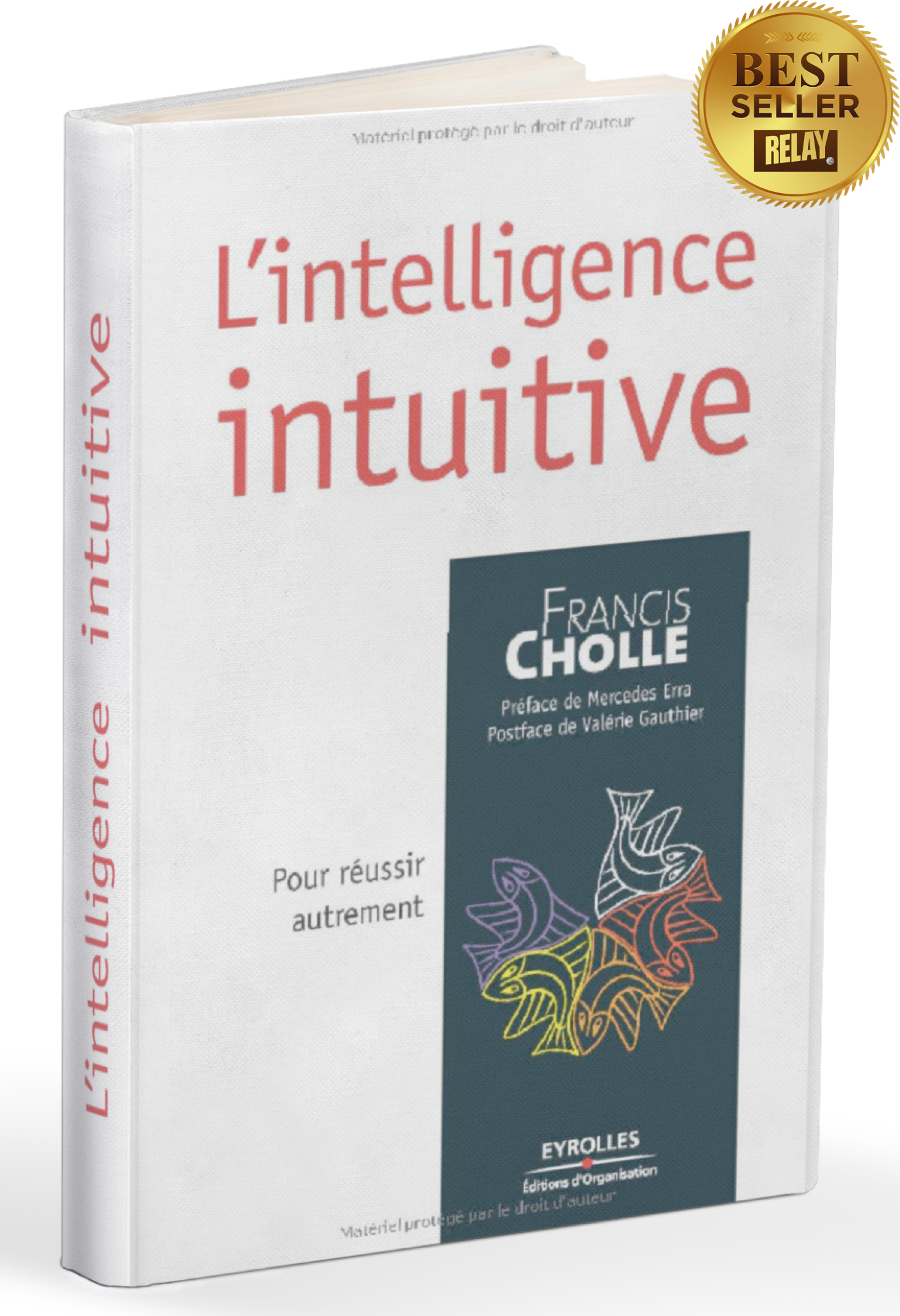
Francis Cholle author of L'Intelligence Intuitive recommends to executives to combine their analytical mind with their intuitive aptitudes to gain further consumer insight and improve business performance.

From our correspondent in the Sillicon Valley, Laetitia Mailhes
 
For beauty and fashion executives time has come to reconsider every aspect of business. "The economy is changing consumers' behaviors, independently from the evolution of incomes, explains NY Fashion Institute of Technology Professor Stephan Kanlian. To open their wallet consumers today want more than brand prestige. They demand more and more added value and a greater match between products they buy and their own values." But the business community is not well prepared to adapt to such a radical change.

"Obsession for financial return has led leaders to often forget they share a common humanity with consumers," says Francis Cholle, author of L'Intelligence Intuitive, innovation consultant for large corporations and advisor to their C-Level executives. A graduate of the best European business school, HEC (Ecoles des Hautes Commerciales) Francis Cholle insists that sustainable value creation requires the necessary synergy between analysis and ROI on the one hand and play and instinct, on the other (see graph below of The Intuitive Compass™).

intuitivecompass.gif


The role of intuitive intelligence

"Neuroscience showed in 2005 that parts of our brain traditionally associated with our instinct are involved in our most sophisticated decisions" says our expert in reference to MIT Picower Institute for Learning and Memory research on our reptilian brain aka instinctual brain, published in the  scientific journal Nature. "It is very noticeable in consumer behaviors. For this exact reason if a company wants to understand its market and meet its expectations, it is necessary that they  understand how intuition works and integrate an intuitive process in their business approach," adds Francis Cholle. His message is well received. "My daily conversations with Francis Cholle greatly deepen my thinking at a particularly critical time for our company" says Ralph Lauren Fragrances and Beauty President Guillaume de Lesquen, based in New York to orchestrate the brand development on the world stage. 

Long before the economic recession Francis Cholle started to advocate the role of intuitive aptitudes and their impact on value creation. Biotherm for Men global marketing director, Charles Haddad is quite satisfied that he could attend one of Francis Cholle's seminar and acquire tools that explain in a simple language many key aspects of brand development and marketing that he could confusedly feel but could not clearly understand even less so replicate. Today Charles Haddad  encourages in his team " free and spontaneous communication. We then select what we feel is relevant". "It is not about leaving behind our marketing objectives but rather about dissolving automatic censorship mechanism often inherent to corporate structures."

Armand de Villoutreys, CEO of Firmenich in Paris and president of Firmenich Fine Fragrance World Division, asserts that he has "learned to approach differently his leadership role in a creative corporation." And it showed very tangible results! "We started four years ago to integrate into our management practices the principles of Intuitive Intelligence," says the French executive. "We have been happy to see an accelerated growth of our financial results across continents well above market average." 

© Les Echos n° 20486 dated 08-13-2009 p. 06 (Authorized translation by Peter Camo)

sustainable.jpg

In their recent article Why Sustainability Is Now the Key Driver of Innovation [Harvard Business Review September 2009], Ram Nidumolu, C.K. Prahalad, and M.R. Rangaswami argue that sustainability isn't a burden on the bottom line; instead, they make the case that going green can lower costs and increase revenues.

They make the point we have been making at The Human Company for some time now: only companies that make sustainability a goal will achieve competitive advantage.

Corporate sustainability does not bloom without effort, however, and the authors describe a 4-phase maturity model for the process:

sustainabilitystages.gif
 
In our experience, we find most that far too many companies view sustainability as a "corporate social responsibility" and not as an engine for growth.

Let's call this STAGE 0: GreenWashing - paying lip-service to sustainability. In this phase,companies view sustainability as a PR exercise, as a community building initiative, but they let it fall far of its true potential. For them, this is corporate citizenship, not competitive advantage.

At this phase, we also see that there is no accountability for sustainability. Often, it is the CEO's job.  This is a cop-out of course, but the data is clear:

sustainabilityresponsible.gif

To add insult to injury, the next step often ends up with the "coronation" of a corporate "sustainability officer" - which again is simply the wrong approach.

Fortunately there are examples of companies that are using intuitive intelligence to challenge their traditional assumptions and create real solutions for lowering costs, eliminating waste, creating new products and services, and even changing their global business models.

Wal-Mart, for example has  taken the greening of its supply chain very seriously. The release of data on its scorecard for the environmental friendliness of its vendors' product packaging, is a clear, measurable initiative which is already impacting over 2000 suppliers. 

The Wal-Mart scorecard evaluates the "green quotient" of product packaging based a number of attributes, such as:

  • Greenhouse gas emissions related to production
  • Materials used
  • Product to packaging ratio
  • Cube utilization
  • Recycled content usage
  • Innovation
  • The amount of renewable energy used to manufacture the packaging
  • The recovery value of the raw materials and emissions related to transportation of the packaging materials.
Wal-Mart also announced plans for an similar scorecard for their electronics suppliers in 2008. Criteria for the electronics scorecard includes:

  • Energy efficiency
  • Durability
  • Upgradability
  • End-of- life solutions
  • Size of the package containing the product
  • Ability to use innovative materials that reduce the amount of hazardous substances, such as lead and cadmium, contained in the product
View a Wal-Mart green supplier scorecard here>>

Then there's GE.  Of course, we've all seen their "ecomagination" campaigns on TV and print, but they have have taken that all important real step to transforming their product innovation process in ways that can only be described as radical.

Instead of appointing a GE Tsar of sustainability, Jeffrey Immelt brought in Professor Vijay Govindaran as their Chief Innovation Consultant. His job, to work with specific divisions to identify real opportunities for global products and services.

The approach they created "reverse innovation," is outlined in How GE is Disrupting Itself (Harvard Business Review, October 2009). VG describes their thinking as follows:


More information on the process here >> 

Why does intuitive intelligence help you think in sustainable terms?

The answer is very simple.

Our instinct is responsible for the survival of our species. We can reasonably say that human instinct is pretty reliable because it's helped us survive successfully for thousands of years.

Our modern thinking, however, relies on our analytical intelligence. It's brought along the prowess of the scientific mind. The problem with this approach is that without genius scientific thinking can be very linear and very exclusive - to the point that it excludes our instinct not complying with reason.

Intuitive Intelligence blends our analytical mind with our instinctual aptitudes. Necessarily, it brings balance to our thinking. The  Intuitive Compass™ facilitates sustainable business thinking and helps us design sustainable business models.

Intuitive Intelligence can be learned and developed, provided we accept that today most of us are not thinking but simply being logical, we can open up to this new mindset.

Why is it necessary to use intuitive intelligence?

Because we will not be able to solve current problems with the outdated way of analytical thinking that created these exact problems.

We face a sustainability imperative. We have to develop and use an intelligence that can think in sync with our ecosystems - in other words an intelligence that understands and respects the creative process of life.

All great scientists recognize that the history of our universe is the consequence of a number of fundamentals laws explained by science as well as a long series of unexplained accidents. Logic alone cannot explain everything. The same goes for business.

In order to help you engage the creativity of your teams, in order to inspire long lasting respectful relationship with consumers, in order to design innovative, sustainable and profitable business models, in order to lead organizations into a successful and sustainable future we developed an original model: The Intuitive Compass™.

How does the Intuitive Compass™ help companies achieve breakthroughs in sustainable innovation?


intuitivecompass.gif

We use the The Intuitive Compass™ as a tool to assess and chart progress as companies (and executives) learn to harness intuitive intelligence in four key areas:

Strategy: how to employ intuitive intelligence to create sustainable, innovative business models which deliver real value to customers in their local environment.

Leadership: the transformative power of intuitive intelligence energizes and builds movements - with clarity of vision and purpose.

Work Culture: the ecosystem health of your business culture is reflected in your bottom line results. The Intuitive Compass™ helps create the open culture you need to succeed in the intelligent economy.

Consumer Needs: map your customers needs and wants using The Intuitive Compass™ - creating a value innovation agenda for your customers.

We help companies and leaders get a "southwest" perspective, and focus on creating sustainable value. Our mantra: sustainable business is a the core of future business success.

Intuitive intelligence can be a matter of life and death.

In Iraq, we learn that the use of intuition by US soldiers has led to numerous close escapes. This article in the New York Times gives us a glimpse of how soldiers may use their intuitive senses to avoid danger:

"On one route sweep mission, there was a noticeable I.E.D. in the middle of the road, but it was a decoy," said Lt. Donovan Campbell, who in 2004 led a Marine platoon for seven months of heavy fighting in Ramadi and wrote a vivid book, "Joker One," about the experience. "The real bomb was encased in concrete, a hundred meters away, in the midst of rubble. One of my Marines spotted it. He said, 'That block looks too symmetrical, too perfect.' "

These life-and-death decisions must be made instantly, with little, if any, time for rational analysis.  And what's more impressive, the Army has discovered that this ability to think intuitively can be improved through training.

Time after time, the Army learns from its feet on the ground, that "the speed with which the brain reads and interprets sensations like the feelings in one's own body and emotions in the body language of others is central to avoiding imminent threats."

Of course, intuitive intelligence is not a new idea for the Army. In COUP D'OEIL: STRATEGIC INTUITION IN ARMY PLANNING, a 2005 document produced by Strategic Studies Institute at US Army War College, we see a serious attempt to blend both analytic and intuition.  

The Army views the analytic approach as follows:

Analytic decision-making approaches a problem systematically. Leaders analyze a problem, generate several possible solutions, analyze and compare them to a set of criteria, and select the best solution. The analytic approach aims to produce the optimal solution to a problem from among those solutions identified. This approach is methodical, and it serves well for decision-making in complex or unfamiliar situations by allowing the breakdown of tasks into recognizable elements. It ensures that the commander and staff consider, analyze, and evaluate all relevant factors.

It may help inexperienced leaders by giving them a methodology for their lack of experience. The analytic approach to decision-making serves well when time is available to analyze all facets affecting the problem and its solution. However, analytic decision-making consumes time and does not work well in all situations--especially during execution, where circumstances often require immediate decisions.

Intuition, on the other hand, is viewed as a "creative" approach:

Intuitive decision-making is the act of reaching a conclusion that emphasizes pattern recognition based on knowledge, judgment, experience, education, intelligence, boldness, perception, and character. This approach focuses on assessment of the situation versus comparison of multiple options. It is used when time is short, or speed of decision is important. Intuitive decision-making is faster than analytic decision-making in that it involves making decisions based on assessment of the situation rather than a comparison of multiple COAs (Courses of Action). It relies on the experienced leader's ability to recognize the key elements and implications of a particular problem or situation, reject the impractical, and select an adequate (rather than optimal) COA.

Intuitive decision-making is especially appropriate in time-constrained conditions. It significantly speeds up decision-making. Intuitive decision-making, however, does not work well when the situation includes inexperienced leaders, complex or unfamiliar situations, or competing COAs. Additionally, substituting assessment for detailed analysis means that some implications may be overlooked. Commanders use intuitive decision-making when time is short and problems straightforward. It is usually appropriate during execution.

The Army, especially in light of Iraq, has revised their thinking. The author of the report, a Columbia Professor William Duggan shows how to reconcile analytical and intuitive methods of decision-making by drawing on recent scientific research that brings the two together. He applies this new research to the Army's core methods of analytical decision-making as found in Field Manual (FM) 5-0, Army Planning and Orders Production. The result is "strategic intuition," which bears remarkable resemblance to von Clausewitz's idea of coup d'oeil in his classic work, On War.

The Columbia professor states emphatically:

This divide between analysis and intuition reflects an outmoded view of the human mind that science no longer supports. Recent advances in how the mind works have overturned the old idea that analysis and intuition are two separate functions that take place in two different parts of the brain. In the new view, analysis and intuition are so intertwined that it is impossible to sort them out. There is no good analysis without intuition, and no good intuition without analysis. They go together in all situations. Some scientists call the new model of the brain "intelligent memory," where analysis puts elements into your brain and intuition pulls them out and combines them into action.

It is important to note that this ireport does not criticize the Army or its commanders. When strategic intuition was used as a lens to analyze Army officers in action, they tend to comment, "That's what we do."  The report states: Good commanders use intuitive intelligence. They treat manuals only as guides, and adapt procedures as they see fit.

And that, ladies and gentlemen, is why you need Intuitive Intelligence - it is the bridge between analysis and intuition, and it explains how we, in fact, really make decisions. Despite the limited visibility in these uncertain and turbulent times, we know that Intuitive Intelligence is the necessary strategic aptitude for decision-makers both in the Army and in the chaotic world of today's business.

If you have not already read "The Big Shift Index" report from The Deloitte Center for the Edge led by John Hagel III, John Seely Brown, and Lang Davison you should do so immediately.


This first release of the Shift Index reveals a startling fact: the return on assets (ROA) for U.S. firms has steadily fallen to almost one-quarter of 1965 levels; at the same time,  the researchers found modest improvements in labor productivity.


Grim news, indeed. The report also finds:


- The ROA performance gap between winners and losers has increased over time, with the "winners" barely maintaining previous performance levels, while the losers experience rapid deterioration in performance.


- The "topple rate," at which big companies lose their leadership positions, has more than doubled, suggesting that "winners" have increasingly precarious positions.


- U.S. competitive intensity has more than doubled during the last 40 years.


- While the performance of U.S. firms is deteriorating, the benefits of productivity improvements appear to be captured in part by creative talent, which is experiencing greater growth in total compensation. Customers also appear to be gaining and using power as reflected in increasing customer disloyalty.


- The exponentially advancing price/performance capability of computing, storage, and bandwidth is driving an adoption rate for our new "digital infrastructure" that is two to five times faster than previous infrastructures, such as electricity and telephone networks.
                                     

The Shift Index consists of three indices: Foundation, Flow, and Impact, and 25 metrics that together quantify the stock, pace, and implications of the shift. The index enables analysts to anticipate changes, identify bottlenecks, and guide strategy. Not everyone, of course, will choose to monitor the same metrics or assign them the same weights.  Thus, the Shift Index is less a single measure and more an informational platform that will give rise to a diversity of models and, a stronger collective sense about the pace and nature of change, constraints and opportunities within that system.  As constraints fall away and opportunities increase, old configurations become unstable and new structures emerge.


A number of key ideas in the report resonated with our observations at The Human Company:


- the importance of creativity and innovation in ROA

- information "flows" over information "stocks"

- passion as a driver for higher productivity

- more and more discriminating consumers

- consistently declining return on assets

- increasing rate at which big companies lose their leadership positions

- rising executive turnover tied to increasing performance pressures


However, I was surprised to find one element missing in their measurement model.


What's missing? Sustainability and its impact on the economy.


Sustainability is the business imperative for our time. From global-warming to competition for natural resources, sustainability must necessarily sit at the core of any sound business strategy. The sooner businesses understand this the better.


Organizations will have no choice but to follow government regulations and anticipate consumers reactions and merciless communication via ever more powerful social networks aiming at securing a healthy future.


More importantly employers who align their businesses to create a more sustainable world will also attract, retain and empower more and better employees. Sustainability challenges have become so pressing that they not only affect us at a rational and emotional level but they also threaten our survival instincts. And  as such they are bound to impact employee productivity, loyalty, and creativity. Meaning is the underpinning and decisive factor of human efficiency. How could a corporation careless of its employees' and employees' children future ever encounter long term success in a flat world?


In order to maintain competitivity, growth and profitability organizations will have to build sustainable blueprints for the future. Take a look at Adam Werbach's latest book: Strategy for Sustainability.

The Deloitte report is an example of a brilliant work conceived in an intellectual tradition largely limited to our analytical minds. Yes, they do mention creativity and talent and yes, they talk about information flows, but I wish they had mentioned sustainability. A quick glance at the Intuitive Compass shows us that Deloitte overlooked the South West Quadrant. Regrettably, this is often the case with our business thinking.

intuitivecompass.gif


Going forward, we cannot leave out the importance of our reptilian brain in its relentless ability to impact every second of our lives and its superior intelligence to sustain our species and hence help us make the best business decisions for a sustainable future (1).

Here's looking forward to the the 2010 Shift Index; I hope to see a section on sustainability and a study on the decisive intangible dimensions of value creation which intuitive intelligence is designed to help us reckon with.

(1) In 2004 MIT School of Science Picower Insititute for Learning and Memory has shown that the basal ganglia which are parts of our reptilian brain are involved in our most sophisticated decision processes (Nature, Feb 24 2005)

Those who criticize Obama’s speech as “just words,” would be well advised to look at history. 

In a scene reminiscent of JFK in Berlin and Ronald Reagan exhorting Gorbachev to “tear down the wall,” Barack Obama has taken the initiative with the culture impasse between the West and communities across the Muslim world. 

His speech in Cairo has set a new benchmark for leadership:


Not only did he manage to state his case with firmness and resolve, he was able to break through the years of mistrust by standing and acknowledging the truth on both sides. 

His sincere yet calm delivery struck the right chord with the people in the streets of Cairo. So says Annelle Sheline, a Cairo-based American journalist:

In a taxi, I asked the driver for his opinion, and he launched into a happy spiel in heavy Cairene about Obama wanting peace and trying to make all the countries of the world work together. When I asked if this was possible, he responded that there had never been a president like Obama in the US, and therefore, “Aiwa, mumkin” (Yes, it’s possible).

His strategy was to understand that the imagination of the people resides in the South-West Quadrant of the Intuitive Compass.  He examines the hopes of the people in the street, and addresses them.  

Sheline tells us that Dalia Mogahed, the executive director of Gallup’s Center for Muslim Studies had outlined the three points indicated by polls that Muslims wanted to hear.

Respect.
Respect from the United States for the religion of Islam and for Muslim cultures.


Cooperation.
No more unilateral action, but cooperation between equal partners.

Issues.
Address the policies of the United States that have angered Muslims on key issues, including Palestine, Iraq, Guantanamo, etc.

Without respect no trust can be established - without trust little creativity and substance can unfold; without equality there is no real long lasting effective change; and, without integrity and introspection there is no growth. Obama’s speech touched on each one of these cornerstones. 

Obama seized the initiative and brought the voice of reason back to the table. The President is, like it or not, a living symbol - and nothing is more powerful than symbolic action in an atmosphere of suspicion and hostility. The Times reports:

Barack Obama must have said something right if Osama bin Laden, Ayatollah Khamenei of Iran and the Jewish settlers on the West Bank all lined up to denounce his speech to the Arab and Muslim worlds.

For too long, the dialog on the future of the Middle East has been dominated by extreme voices.  Obama’s speech spoke directly to the aspirations of the common man. He humanized America, by opening up and sharing his personal story.

Words are the weapons of change.  Just ask Ted Sorensen.

And now, we see signs that the “Obama Effect” may be sweeping across the Middle East. Iran’s election too, has become a referendum for change.

Earlier, we saw Obama’s overtures in Turkey. The political commentators who were concerned that Barack Obama’s visit to Turkey was high on style but low in substance may not be as right they believe they are. Their view is focused on the North-East Quadrant of the Intuitive Compass™ - they are focused on measurable results and timelines.

Let’s look at a historical snapshot of public opinion in Turkey, courtesy of Gallup:

gallup_turkey.gif 

Question: If the U.S. can’t get any respect in Turkey, a “secular” democracy, how can they  achieve any progress in the Arab world at all?

Flashback: The last attempt at winning the “hearts and minds” of the Muslim world ended in shambles when Bush’s fellow Texan and close friend, Karen Hughes, walked away from the job in total failure. And before her there was the Charlotte Beerspropaganda show.

All of which makes President Obama’s short trip to Turkey even more spectacular. He accomplished in two days what the PR-experts couldn’t accomplish in eight years, and he didn’t waste a billion dollars.

How, you ask?

Watch this video of Obama talking to the youth:


These are the same students, who according to  to Rupert Murdoch’s Wall Street Journal, have, for the past eight years,”fostered deep anti-American sentiments exacerbated by an unpopular war in Iraq and a perception that the U.S. is biased toward Muslims.” 

What we are witnessing in Obama is the promise of authentic leadership which speaks directly to the heart of people.  The most powerful leader of the most powerful country in the world stood in the center of a circle of Turkish students in a university to address their concerns.  The circle = cooperation, the center = respect, and addressing concerns = the truth.

With his speech in Cairo, Obama knocked down the psychological wall which separates western culture and the mindset of Islam - now the work at hand is to reach across the wall and shake hands for a brighter future for all.  That will happen through the concrete actions people take in the weeks and months ahead.

logoloreal.gif

According to a recent report in the Wall Street Journal, L'Oréal SA, the world's largest cosmetics maker, reported flat sales for the first quarter of 2009 as consumers shied away from its luxury skin creams and shampoos in favor of its cheaper brands. The maker of products ranging from Giorgio Armani perfume to Lancôme skin cream and Maybelline eye shadows said sales increased 0.3% to €4.37 billion ($5.83 billion) in the first three months of 2009. Jean-Paul Agon, L'Oréal's chief executive, said that he would not offer specific guidance for the year but that results would "improve" during 2009.

After accounting for the effect of currency fluctuations, sales fell 9.3% in Western Europe and 5% in North America. This shortfall was partly offset by an increase in revenue in Asia.

Sales at L'Oréal's luxury cosmetics division fell, while sales of its consumer drugstore lines increased slightly.

This is an unfortunate turn for L'Oréal which has always been known for its commitment to scientific research and exceptional financial results.

In fact, you might say there is an unresolved tension in its culture between creativity and business results. This tension is visible even on its website. If you read about the "profiles they are looking for" under the marketing category, here's a description you'll find:

Creativity, imagination, openness to new ideas - coupled with the highest professionalism.
• Project-oriented, natural team player, at ease working with others in an environment of entrepreneurial challenge.
• Global-minded, flexible, able to juggle multiple priorities.
• Strong analytical thinker, excellent communicator.

You have a keen eye on the latest fashions, a finger on the pulse of emerging consumer and cultural trends. Highly developed interpersonal skills, a passion for results. The personality to make a difference.

Diagnosis: L'Oréal - When East dominates West...                

For the past few years I have been working with L'Oréal to change this dynamic.

The challenge: help marketers and managers develop a sensitivity to the creative nature of the beauty product development process and specifically gain an understanding for the process of research and development.

When the cosmetic group decided to develop a world wide talent appraisal process Sir Lindsay Owen Jones articulated the need to develop a competence key to the success of the group in the eye of the CEO, and that is: sensitivity to métier. What Sir Lindsay Owen Jones was aiming for was to develop a global, shared understanding for beauty products development, for L'Oréal customers, and for a number of other confidential important characteristics identified by the CEO as key factors for success in the beauty industry.

The Human Company was commissioned to research how to define this specific aptitude and how to develop it and train for it. We developed an international training track that is seen today as one of the most successful and inspiring training program available at L'Oréal.

Our approach consists in helping marketers understand how to engage and inspire creative people to contribute the best of their creativity.  We used the The Intuitive Compass™ to highlight the tension between results-driven managers and creative teams.

compass_loreal.gif

Our analysis: L'Oréal has a product innovation driven business model whereas most of its competitors have often a market-driven model. The company believes in scientific innovation to promote growth. Its founder was a scientist. It is how L'Oréal sustained 20 years of double-digit growth and became the world leader in cosmetics. There is, as I mentioned earlier, a tension in its culture between creativity and business results.

Results: We helped L'Oréal's teams understand the perspective of the different teams.  The creative teams learned about the business aspects they had neglected, while the managers and marketers were helped to understand the creative process. The bridge is intuitive intelligence. Our training program is seen today as one of the most successful and inspiring training program available at L'Oréal. (Average rating: 19.5/20) because it is very relevant with the innovation imperative prevailing in the beauty Industry, articulated by the CEO Jean Paul Agon in his mandate. 
I just got back from delivering the keynote at the Fashion Institute of Technology's 2009 Capstone Presentations and Graduation Reception.

Over the past few weeks, I've seen how teams of students have used the ideas we discussed, both on creativity and applied intuitive intelligence, to learn more about the possibilities for exploring new avenues for growth. They are full of enthusiasm and passion for their work - and that is what true education is about. May they keep the fire with them always!

fit1.giffit2.gif
Thanks to everyone for such a wonderful evening: FIT's Dr. Joyce Brown and Professor Stephan Kanlian, our gracious hosts;  my industry colleagues: Karen Grant, Marc Gobe, Candace Corlett, and Mark Pritchard; and of course, Ellen Byron from the Wall Street Journal.

And most importantly, thank you to the students.  Yours is the task of building a tomorrow that keeps us alive, hopeful, and yes, sometimes, truly joyful!

My keynote presentation is available here >>